Mazatlán Telecommunications
Staying seamlessly connected is highly straightforward in Mazatlán. Modern high-speed fiber networks, widespread mobile coverage, and accessible cellular frameworks ensure expats and travelers remain in close touch with home.
To help you coordinate your connectivity, this directory provides verified local information regarding Cell Phones, High-Speed Internet, US and Canadian Television Alternatives, and Pay Phone Logistics within the municipality.
Cell Phones & SIM Cards
Setting up cellular service is exceptionally affordable. If you are staying in Mexico for more than a couple of weeks, buying a local prepaid physical SIM card or downloading an eSIM from Telcel (the country's largest network) is highly strategic.
Prepaid plans called Amigo packages are purchased at any local OXXO corner store or Telcel customer care office. For roughly $200 MXN to $300 MXN pesos, you can activate a month of unlimited calls and texts back to Canada and the United States, bundled with plenty of data. It is often significantly cheaper than paying international roaming surcharges to your home provider!
High-Speed Internet Access
High-speed fiber-optic connections are widespread across Mazatlán, with local providers like Telmex (Infinitum), Totalplay, and Megacable delivering speeds up to 500 Mbps. Widespread free Wi-Fi is standard at most modern coffee shops, beach clubs, and dining patios throughout the Golden Zone and Historic Center.
While almost all hotels and vacation rentals bundle complimentary Wi-Fi, it is always wise to confirm download bandwidth speeds directly with your host beforehand if you are working remotely. For off-grid remote settings, high-speed Starlink Satellite Internet is fully active and incredibly reliable throughout Sinaloa.
US & Canadian TV Alternatives
For long-term residents, keeping track of home sports, news, and network entertainment is simple, but the technology has changed. Historically, Canadian snowbirds used localized satellite providers like MazSatellite to point dishes toward Canadian satellites.
However, because Rogers/Shaw Direct decommissioned the south-pointing satellites that leaked signals below the border, Canadian satellite TV dishes no longer function in Mexico. Today, almost all expats have transitioned to high-speed IPTV (Internet Protocol TV) streaming services, Amazon Firesticks, or Apple TV devices paired with a premium VPN to bypass regional content blackouts.
Pay Phones in Mazatlán
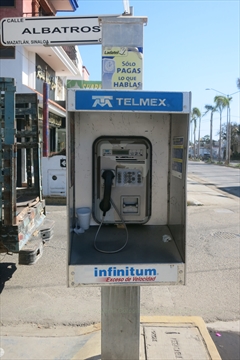
Traditional coin-operated public pay phones are completely obsolete and have been systematically decommissioned throughout Mazatlán. Due to the extreme affordability of local mobile devices and widespread public Wi-Fi networks, travelers rely exclusively on cellular devices for emergency and casual calling needs.